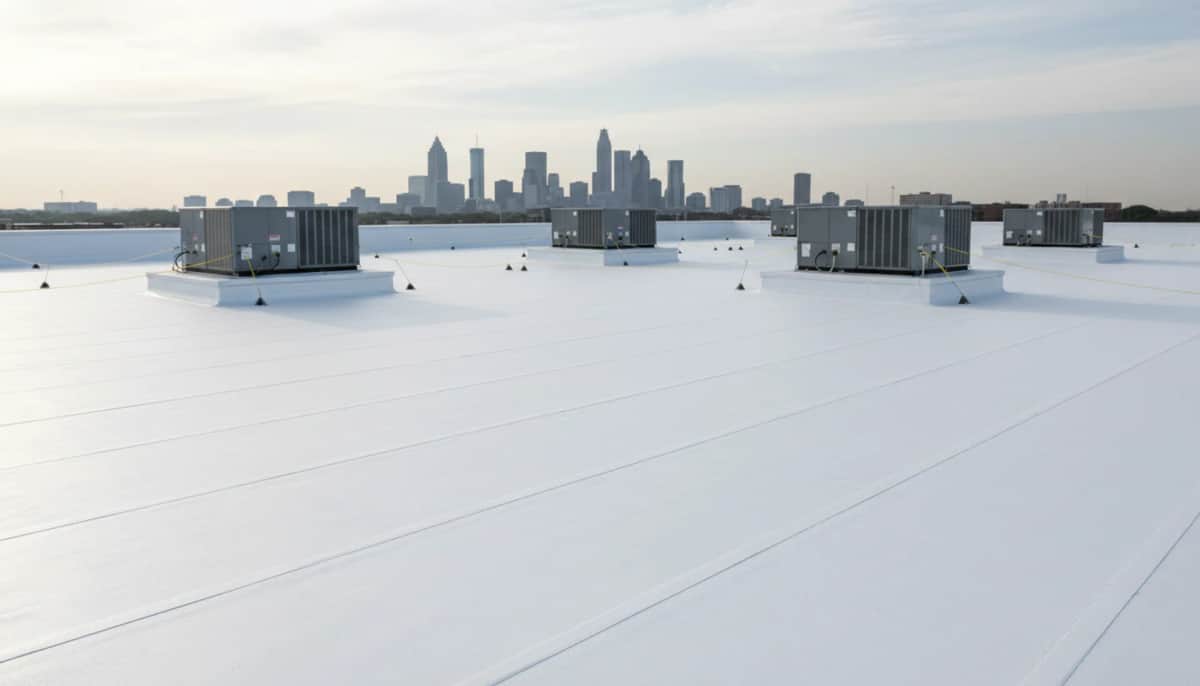
PVC Roofing for Restaurants & Industrial Facilities
Premium PVC roofing membranes with ultimate chemical and grease resistance. Ideal for food processing and restaurant environments.
Trusted by industry leaders






What PVC Roofing delivers on a commercial roof.
PVC (Polyvinyl Chloride) is the premium single-ply roofing option for facilities that require maximum chemical resistance. Its unique chemical structure makes it immune to animal fats, grease, and industrial oils that would destroy other roofing membranes.
How the system is built.
PVC roofing is made from a combination of polyvinyl chloride, plasticizers for flexibility, and stabilizers for UV protection, reinforced with a high-strength polyester or fiberglass scrim.
Why specifiers choose PVC Roofing.
Ultimate Grease Resistance
The only single-ply system that can withstand constant exposure to cooking grease, oils, and industrial chemicals.
Fire Resistance
Naturally fire-resistant and self-extinguishing, making it a safer choice for high-risk industrial environments.
Heat-Welded Strength
Like TPO, PVC seams are heat-welded to create a permanent, monolithic bond that is stronger than the sheet itself.
High Reflectivity
Meets or exceeds Energy Star and LEED requirements for solar reflectance and thermal emittance.
The numbers behind the system.
| Thickness Options | 50, 60, 80 mil |
|---|---|
| Reflectivity | 87% Initial |
| Fire Rating | Class A Self-Extinguising |
| Oil Resistance | Exceptional |
| Max Warranty | 25-Year NDL |
Where PVC Roofing works hardest.
Where we install PVC Roofing
- Restaurants & Food Service
- Food Processing Plants
- Chemical Manufacturing
- Airports & Hangers
- Premium Retail Properties
What you get long-term
- Best protection for grease environments
- Superior fire safety performance
- Lifetime flexibility with premium plasticizers
- Resistant to high-alkaline conditions
PVC Roofing: The Only Responsible Choice for Grease-Intensive Facilities
If you own a restaurant or food processing facility, your roof is under constant attack from rooftop exhaust fans that deposit grease and animal fats onto the membrane. While these substances will cause TPO and EPDM to soften, swell, and eventually fail, PVC (Polyvinyl Chloride) remains unaffected. Capital City Roofing has rescued dozens of restaurant roofs that were prematurely destroyed by grease after the wrong system was installed. Our PVC systems are engineered from the molecular level to resist chemical degradation. Furthermore, PVC is inherently fire-resistant. Unlike other membranes that fuel a fire once ignited, PVC is self-extinguishing and will stop burning once the heat source is removed. For coastal properties or facilities near industrial plants, PVC also provides the best defense against high levels of salt spray and airborne pollutants.
Questions specifiers ask about PVC Roofing.
Why is PVC more expensive than TPO?
PVC uses more expensive raw materials and complex plasticizers to achieve its unique chemical and fire resistance. The higher upfront cost is offset by its specialized performance.
Can PVC handle standing water?
Yes, PVC's heat-welded seams are completely watertight and the membrane itself is highly resistant to rot and microbial growth in ponding water areas.
Is all PVC the same?
No. Capital City Roofing only uses high-molecular-weight PVC with non-migratory plasticizers to ensure the roof remains flexible for its entire 20-30 year service life.
What Customers Say
Google review snapshot audited October 5, 2026.
“I can't say enough good things about Capital City Roofing. From start to finish, the entire team was professional, knowledgeable, and genuinely committed to delivering high-quality work.”
Other flat roof options.
Certified PVC Roofing installers.
On time. On budget. With the manufacturer-backed coverage your specifier expects.