Why Hyperscale Data Centers Spec 80-Mil White TPO (And What It Means for Your Building)
Walk a hyperscale roof and the same spec sheet appears almost every time: 80-mil white TPO or PVC over tapered polyiso, with a secondary waterproofing layer beneath the primary membrane. Here's why - and what the same spec is doing on regional colocation and AI training facilities across Georgia, Tennessee, and South Carolina.
Walk the roof of any new hyperscale data center built in the last five years and you will see something close to the same spec sheet: 80-mil white TPO or PVC, mechanically attached or fully adhered over tapered polyiso, with a secondary waterproofing layer beneath the primary membrane and ANSI/SPRI-compliant edge details. This is not a stylistic preference. Every line of that spec exists for a measurable, dollar-quantified reason. As Capital City Roofing supports the data center buildout across the Atlanta, Nashville, Charleston, and Austin markets, we run into this same spec on bid sheets again and again. Here is what is behind it.
The 80-Mil Membrane: Built for Foot Traffic
A typical big-box retail or warehouse roof is fine with a 60-mil TPO membrane. The roof gets walked perhaps once a year. There are no concentrated mechanical loads beyond the HVAC units. The membrane warranty stretches comfortably to 20 years.
Data centers are different. The CRAC (computer room air conditioning) units, condensers, chillers, and cooling towers that keep server halls below 80 F operate continuously and require frequent service. A 100,000 sq ft data hall can have hundreds of rooftop mechanical units. Technicians are on the roof weekly, sometimes daily. They drag tool bags, drop wrenches, push service carts, and walk routes that concentrate wear in predictable patterns.
A 60-mil membrane under that traffic pattern in Atlanta, Texas, or Carolina summer heat will not reach eight years. The 80-mil membrane provides 33% more puncture resistance, longer warranty service life under heavy traffic, and a defensible answer to the question every data center owner eventually asks: 'why does this roof need to be replaced again?'
Walkway pads laid along the predictable service paths extend life further. We install them as standard on every mission-critical project.
The White Surface: ENERGY STAR, CRRC, and Cooling Cost
Cooling is the largest single line item in any data center's operating budget. Industry studies consistently report 30-40% of total facility energy goes to cooling. A roof that absorbs less solar energy reduces that cooling load directly.
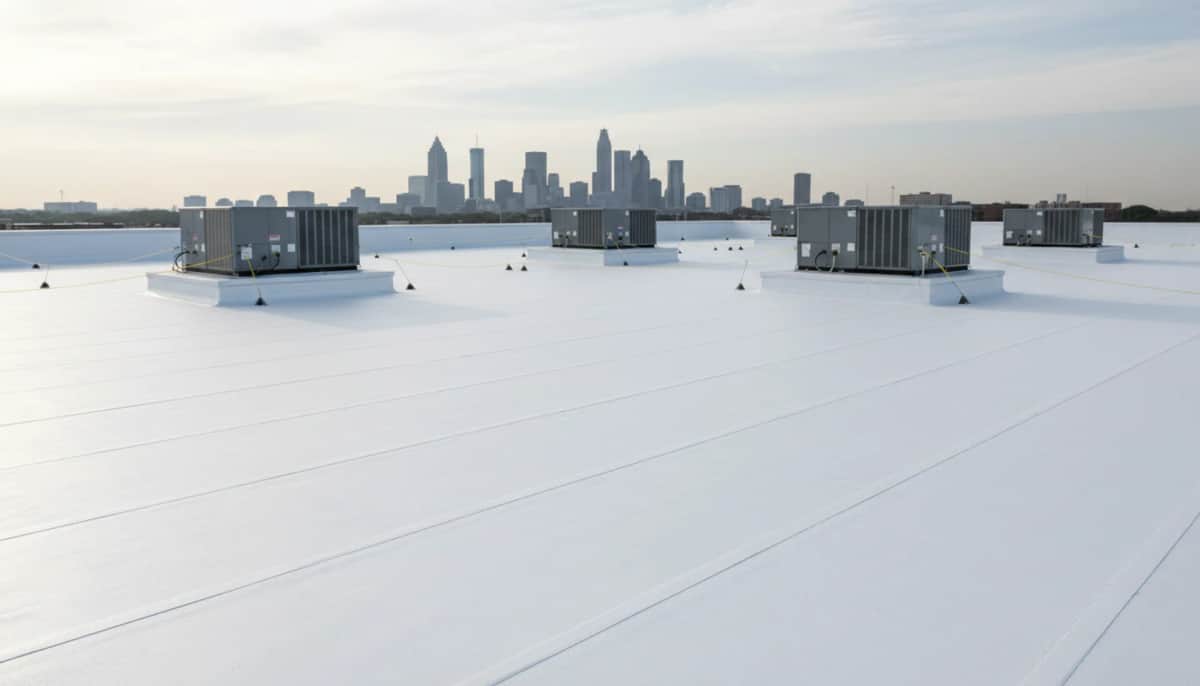
White TPO membrane carries a solar reflectance of 0.79 to 0.87 and a thermal emittance of 0.92 - figures that satisfy ENERGY STAR roof requirements, qualify under the Cool Roof Rating Council, and meet most state cool-roof tax credit thresholds. The IKO InnoviTPO membrane, for example, certifies at 0.78 initial / 0.73 three-year aged solar reflectance with an SRI of 97 initial / 90 three-year aged.
For a 500,000 sq ft data center facility, the difference between a white reflective roof and a dark commercial membrane can move HVAC peak load by single-digit percentages - which translates to hundreds of thousands of dollars per year on the electric bill in the Sun Belt. Owners are explicit about wanting this.
The Redundant Waterproofing: Built to Fail Twice
This is the detail that separates a mission-critical roof from a generic commercial roof, and it is the line item that causes the most confusion when GCs first encounter the spec.
A standard commercial roof is engineered to keep water out. A mission-critical data center roof is engineered to keep water out twice - the assembly is designed so that even if the primary membrane is breached, a secondary waterproofing layer underneath catches the water before it reaches the deck and the data hall below.
The reason is simple: a single membrane breach over a $50M server hall is not an acceptable failure mode. Insurance underwriters know this. Hyperscale owners know this. The redundant assembly is the price of admission for any new construction targeting Tier III or Tier IV uptime levels.
Capital City Roofing installs the secondary membrane to the same FM Global wind/uplift standards as the primary, fully detailed at every penetration, termination, and expansion joint.
FM Global, ANSI/SPRI, and the Insurance Question
Every hyperscale spec we have seen calls for FM Global Approved roof assemblies, FM 4470 wind and hail rating, ANSI/SPRI ES-1 edge metal, and UL 580 / UL 1897 wind uplift compliance. These are not nice-to-haves. They are the standards mission-critical insurers require to write the policy that makes the data center bankable.
Capital City Roofing is a GAF Certified Commercial Contractor and active with the manufacturer programs - GAF, Carlisle, Firestone, Johns Manville, GenFlex - whose membrane systems carry the FM Approval certifications hyperscale specs reference. We are pursuing FM Global Contractor Approval to extend that capability further.
What This Means for Smaller Facilities
The same spec is showing up on smaller facilities than ever before. Edge data centers in retail/industrial parks, AI training nodes co-located inside larger commercial buildings, and Tier II colocation buildouts under 50,000 sq ft are increasingly being specified to the same 80-mil white TPO with redundant waterproofing standard that their hyperscale parents use.
For owners and GCs working on these smaller mission-critical facilities, this matters in three ways:
- The roofing budget is higher per square foot than typical commercial work. A 25-30% premium over standard 60-mil commercial TPO is realistic.
- The contractor pool is smaller. FM Approval, GAF Certified Commercial status, and demonstrated mission-critical experience are increasingly screened during prequalification.
- The maintenance contract should be in place from day one. A mission-critical PM contract at $0.03-$0.10 per square foot per year is standard - and the cost of skipping it is measured in downtime risk, not roof life.
Capital City Roofing's Mission-Critical Practice
Capital City Roofing's commercial division supports new construction, recoats, and 24/7 mission-critical preventive maintenance across Georgia, Tennessee, and South Carolina - the same three-state footprint that hosts many of the fastest-growing data center submarkets in the country. We bring GAF Certified Commercial Contractor status, GAF Master Elite, CertainTeed ShingleMaster Premier, NDL warranties up to 30 years, IR thermography and drone-based condition reporting, and a crew structure built for badged-worker access on live data hall sites.
If you are spec'ing a new hyperscale, colocation, or edge facility - or operating an existing data center anywhere in our footprint - contact our commercial division for a roof assembly review and a mission-critical PM proposal.
What this Means for Your PM Program
If you operate an existing data center or colocation facility, the spec sheet above is one half of the story. The other half is what happens after the roof is installed - the structured preventive maintenance program that keeps it performing to mission-critical SLAs. Read inside a mission-critical roof preventive maintenance program for the visit cadence, IR thermography, drone surveys, $0.03-$0.10/sf pricing, and response-time SLAs that come with the contracts hyperscale and Tier III/IV facilities actually buy.
Learn more: Mission Critical & Data Center Roofing | Flat Roof Systems (TPO/EPDM/PVC) | Commercial Roofing Services
Brad Strawbridge
Founder & CEO · Forbes Business Council Member • RT3 & NRAP Board of Directors • GAF Master Elite® • CertainTeed ShingleMaster™ • NRCA Residential & Workforce Development Committees
Brad Strawbridge is the Founder and CEO of Capital City Roofing, bringing over a decade of hands-on expertise to the industry. He is an official member of the Forbes Business Council, the invitation-only community for vetted senior-level business leaders, and serves on the Boards of Directors of the Roofing Technology Think Tank (RT3) and the National Roofing Apprenticeship Program (NRAP). A member of the National Roofing Contractors Association (NRCA), Brad has been appointed to the NRCA Residential Roofing Committee and the NRCA Workforce Development Committee, helping set national standards for installation quality and the future of the roofing labor force. Under his leadership, Capital City Roofing has achieved elite certifications held by fewer than 1% of contractors nationwide.