Inside a Mission-Critical Roof Preventive Maintenance Program: What Data Center Owners Actually Buy
A data center targeting 99.99% uptime cannot wait for a leak to schedule a roofer - the maintenance contract is the prevention. Here's what's inside a real mission-critical PM program, what it costs, and how it differs from the service plans most commercial buildings buy.
A data center cannot tolerate a roof leak. The Tier III and Tier IV uptime standards that hyperscale and colocation facilities target - 99.67%, 99.982%, 99.995% - leave room for, at most, a few minutes of unplanned downtime per year. A roof leak that drips into a server rack does not get added to a service ticket queue; it gets added to an SEC filing.
This is why mission-critical preventive maintenance contracts are not commodity service plans. They are the prevention - the structured, contractually-defined program that keeps a roof from ever becoming the failure point.
Capital City Roofing supports mission-critical PM contracts across the Atlanta, Nashville, Charleston, and Austin data center markets - new construction, colocation, and edge facilities alike. Here is what is actually inside one of those contracts, what it costs, and why it pays back.
What's in the Visit
A typical Capital City Roofing mission-critical PM program runs on a bi-annual cadence: one spring visit, one fall visit, plus unscheduled mobilization in response to severe weather events or owner-initiated requests. Each visit includes:
Full visual inspection. Membrane field, seams, terminations, perimeter and edge metal, parapet flashings, expansion joints, drains and scuppers, every penetration (pipe boots, vents, equipment curbs, conduit), and rooftop equipment interfaces (CRAC units, condensers, chillers, cooling towers). Defects are catalogued with location, severity, and recommended remediation.
Infrared thermography. A scan of the full roof surface, typically performed in early evening when the deck is releasing daytime solar heat, identifies subsurface moisture before it telegraphs through the membrane and becomes a visible leak. This is the single most important preventive tool for older roofs and the most reliable way to catch insulation saturation before it requires a tear-off.
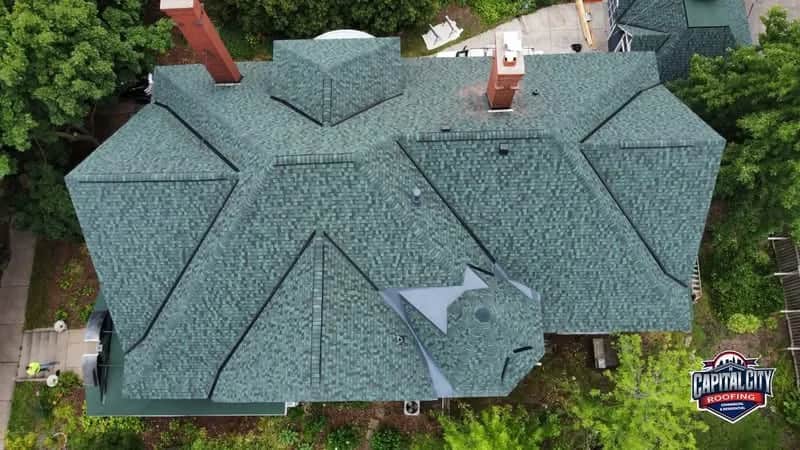
Drone survey. High-resolution vertical and oblique imagery of every roof plane, valley, and termination. The imagery feeds the digital condition log and supports owner asset management systems.
Drain and scupper clearing. Debris, biological growth, and ponded water signatures are removed. Drainage is verified.
Sealant and flashing service. Every mastic, sealant, and pipe boot termination is inspected. Failed sealants are reapplied to manufacturer specification. Flashings showing fastener back-out, lifted edges, or seam separation are repaired in-place.
Annual digital condition report. At year-end, an aggregated report combines both visits' findings - photo documentation, defect map, IR thermography results, drone imagery, capital-planning recommendations for the upcoming budget cycle, and a warranty-compliance attestation. This is the document the owner files with the manufacturer to maintain NDL warranty coverage.
The Pricing
Mission-critical PM pricing typically runs $0.03 to $0.10 per square foot per year, depending on roof complexity, mechanical density, and reporting cadence. The variables that move pricing inside that range:
- Roof size. Larger roofs benefit from per-sq-ft economy of scale.
- Mechanical density. A roof with hundreds of CRAC and condenser units is significantly more time-intensive to inspect than a clean roof of the same square footage.
- Reporting requirements. Some owners want quarterly reports rather than the standard annual report. Some want integration with proprietary asset management systems.
- Response-time SLA. Standard contracts include a defined emergency response SLA - 4 hours, 8 hours, or 24 hours depending on the tier. Faster SLAs cost more.
- Geography. Crew mobilization distance from our Alpharetta, GA headquarters affects pricing for facilities in outlying TN, SC, and TX markets.
For a 500,000 sq ft facility, the math is $15,000 to $50,000 of contracted annual revenue per building. For a multi-building campus - the QTS, Switch, Meta, and Google facilities our footprint - the contract value scales accordingly.
Why It Pays Back
The case for a structured mission-critical PM contract has three parts.
Roof life extension. Industry studies consistently show that a roof under a structured maintenance program lasts 10-15 years longer than a roof that only gets emergency service. On a 25-year roof, that's a 40-60% increase in useful life. Avoiding one premature replacement on a 500,000 sq ft data center roof pays back the entire PM contract at roughly 50x.
Emergency reduction. The same studies show 70%+ reduction in emergency mobilization for facilities under PM contracts. Each emergency call avoided saves the owner the after-hours mobilization premium plus the interior remediation cost (which can run six figures for a single leak over a server rack).
Warranty preservation. Most NDL manufacturer warranties from GAF, Carlisle, Firestone, Johns Manville, and GenFlex require documented professional maintenance to remain in force. The PM report is the documentation that keeps the 30-year warranty alive.
What Sets Mission-Critical PM Apart from Standard Commercial PM
The visit cadence, the deliverables, and the price points of a mission-critical PM contract look superficially similar to a standard commercial PM contract. The differences are operational:
- Badged-worker access. Crews must clear facility background checks, sign NDAs, and follow escorted-roof-entry protocols on every visit.
- Zero-debris protocols. Every tool is tethered, every fastener is accounted for, magnetic sweeps run on every visit. A loose screw on a data center roof is not an inconvenience - it is a service-affecting incident if it migrates to a fan intake.
- Phased scheduling. Live data halls cannot be taken offline for roof work. Scheduling coordinates with facility management around utility maintenance windows, change-control freezes, and uptime-critical periods.
- Documented chain-of-custody. Every photo, every defect, every repair is logged in a system that supports forensic reconstruction if a leak ever does occur.
These differences are why mission-critical PM is a separate service line, why the contractor pool is smaller, and why the price points support a real practice.
Capital City Roofing's Mission-Critical Practice
Capital City Roofing's commercial division supports mission-critical PM contracts across Georgia, Tennessee, and South Carolina. Our crews carry zero-debris kits, magnetic sweeps, and tool tethers as standard. We hold GAF Certified Commercial Contractor status, GAF Master Elite, CertainTeed ShingleMaster Premier, and active manufacturer relationships with Carlisle, Firestone, Johns Manville, and GenFlex - the certifications hyperscale specs reference.
If you operate a data center, colocation facility, or edge node anywhere in our footprint - or you are scoping the PM program for a facility currently under construction - contact our commercial division for a mission-critical PM proposal.
The Spec Sheet Behind the Contract
A PM contract only protects what was installed correctly in the first place. If you are spec'ing a new hyperscale or Tier III/IV facility - or evaluating whether an existing roof can support the mission-critical service tier - the underlying assembly matters as much as the contract. Read why hyperscale data centers spec 80-mil white TPO for the membrane, redundant waterproofing, FM Global, and ANSI/SPRI standards we work from.
Learn more: Mission Critical & Data Center Roofing | Commercial Roofing Maintenance | Commercial Roofing Inspections
Brad Strawbridge
Founder & CEO · Forbes Business Council Member • RT3 & NRAP Board of Directors • GAF Master Elite® • CertainTeed ShingleMaster™ • NRCA Residential & Workforce Development Committees
Brad Strawbridge is the Founder and CEO of Capital City Roofing, bringing over a decade of hands-on expertise to the industry. He is an official member of the Forbes Business Council, the invitation-only community for vetted senior-level business leaders, and serves on the Boards of Directors of the Roofing Technology Think Tank (RT3) and the National Roofing Apprenticeship Program (NRAP). A member of the National Roofing Contractors Association (NRCA), Brad has been appointed to the NRCA Residential Roofing Committee and the NRCA Workforce Development Committee, helping set national standards for installation quality and the future of the roofing labor force. Under his leadership, Capital City Roofing has achieved elite certifications held by fewer than 1% of contractors nationwide.