
Greenville SC Storm Season and Hail Damage Guide: Protecting Upstate Roofs
Greenville and the Upstate SC corridor face some of the Southeast's most intense supercell hail events. This guide covers hail damage identification, Class 4 impact-resistant upgrades, I-85 corridor commercial solutions, and the insurance claim process for Upstate property owners.
If you own property in Greenville or anywhere along the Upstate South Carolina corridor, hail damage is not a question of if. It is a question of when. The I-85 corridor from Spartanburg through Greenville and down to Greer sits in one of the most active severe thunderstorm regions in the Southeast, with supercell storms producing damaging hail from March through October every year.
The Upstate is not the Gulf Coast. It is not tornado alley in the traditional sense. But the combination of warm, moist air from the Gulf colliding with cooler air masses along the Blue Ridge escarpment creates a persistent supercell environment that generates large hail, straight-line winds, and occasional tornadoes with regularity that surprises homeowners who move here from other parts of the country.
This guide covers everything Greenville property owners need to know: how to identify hail damage, when to upgrade to impact-resistant shingles, what commercial property owners along the I-85 corridor should expect, and how to navigate the insurance claim process when a storm hits.
Upstate SC Storm Season: March Through October
Severe weather in the Greenville Upstate follows a predictable seasonal pattern, even though individual storms remain unpredictable:
- March through June: Peak supercell season. Warm-season air masses build rapidly, and the interaction with cooler systems from the northwest produces the strongest storms. This is when the largest hailstones typically fall.
- July through September: Afternoon pop-up thunderstorms driven by summer heating. These storms produce smaller hail (typically quarter-size or below) but generate frequent straight-line wind events that can exceed 60 mph.
- October: A secondary severe weather window as fall fronts push through. Less frequent but capable of producing damaging hail and wind.
The I-85 corridor is particularly vulnerable because the terrain channels storm systems along the interstate path. Manufacturing facilities, warehouses, and distribution centers lining the corridor between Greenville and Spartanburg face repeated exposure season after season.
For homeowners in Simpsonville, Mauldin, Easley, Five Forks, Taylors, and Travelers Rest, the foothills topography can intensify storms as they interact with rising terrain. Properties at higher elevations often experience larger hailstones and higher wind speeds than properties closer to the valley floor.
Understanding Hail Damage to Your Roof
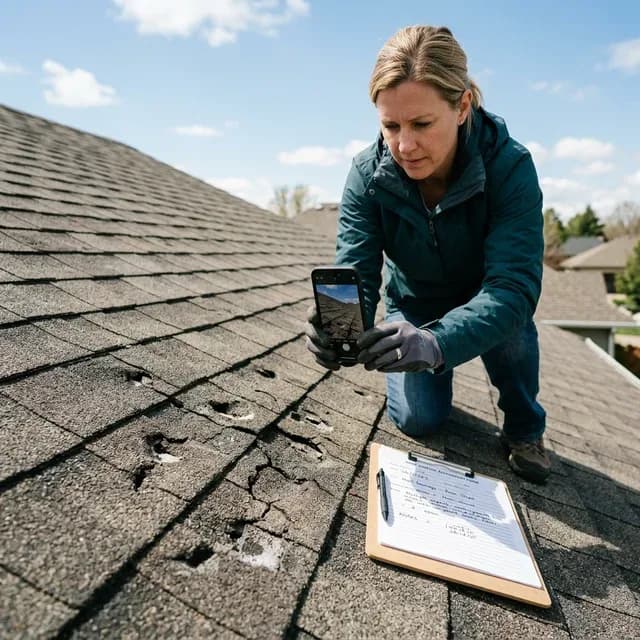
Hail damage is not always obvious from the ground. In fact, the most costly hail damage is often invisible to an untrained eye. Here is what actually happens when hailstones strike your roof:
Granule Loss
Hailstones knock the protective granules off asphalt shingles, exposing the underlying asphalt mat to UV radiation. This accelerates aging and leads to premature failure. A roof that should last 25 to 30 years can fail in 10 to 15 years after significant hail impact.
Mat Fractures
Larger hailstones (one inch and above) can fracture the fiberglass mat beneath the granule layer. These fractures are not visible from the surface but create weak points where water penetrates over time. A mat fracture today becomes a leak two winters from now.
Seal Strip Failure
The adhesive seal strip that bonds overlapping shingles together is vulnerable to hail impact. When the seal strip is broken, wind can lift the shingle tabs, exposing the underlayment and deck to water intrusion. This is one of the most common causes of post-storm leaks in the Upstate.
Bruising vs. Functional Damage
Insurance adjusters distinguish between cosmetic damage and functional damage. Cosmetic damage (minor granule displacement without mat compromise) may not meet the threshold for a claim. Functional damage (mat fractures, seal strip failure, exposed fiberglass) does. The difference is critical for your claim outcome, and it requires a trained eye to document properly.
Hidden Damage
Hail hits every surface of your roof, including areas you cannot see from the ground. Ridge caps, hip shingles, valley intersections, and the areas around penetrations (vents, pipes, skylights) are all vulnerable. A thorough post-storm inspection must cover every square foot.
For a deeper dive into hail damage identification, read our comprehensive hail damage guide.
Class 4 Impact-Resistant Shingle Upgrades
Class 4 is the highest impact resistance rating available for asphalt shingles, tested under UL 2218 by dropping a two-inch steel ball from 20 feet onto the shingle surface. A Class 4 shingle must show no cracking or splitting after this test.
Why Class 4 Matters in Greenville
The Upstate's repeated hail exposure makes Class 4 shingles a smart long-term investment rather than a luxury upgrade. Here is the math:
- Insurance premium reduction: Many South Carolina insurers offer 10 to 28 percent premium discounts for Class 4 impact-resistant roofing. On a $2,500 annual premium, that is $250 to $700 in annual savings.
- Extended roof life: Class 4 shingles resist the cumulative damage from repeated small hail events that progressively weaken standard shingles over multiple storm seasons.
- Reduced claim frequency: Fewer claims mean a cleaner claims history, which protects your insurability and premium rates long-term.
Available Class 4 Options
GAF Timberline HDZ IR (Impact Resistant): The impact-resistant version of GAF's most popular architectural shingle, featuring a modified SBS asphalt formulation that absorbs hail impact without fracturing the mat.
CertainTeed Landmark IR: CertainTeed's impact-resistant architectural shingle with a polymer-modified asphalt core engineered for Class 4 performance.
Both products are available in the full range of color options, so upgrading to Class 4 does not mean compromising on aesthetics. Capital City Roofing installs both systems as a GAF Master Elite and CertainTeed ShingleMaster Premier certified contractor.
Commercial Hail and Storm Damage on the I-85 Corridor
The I-85 industrial corridor between Greenville and Spartanburg concentrates some of the heaviest commercial roofing demand in the Upstate. Manufacturing plants, logistics centers, and corporate campuses line the corridor, and every one of them is exposed to the same severe weather that hits residential neighborhoods.
Lucas Anderson, Jason Breland, and Mary Evelyn Breland lead Capital City Roofing's Greenville commercial division, providing dedicated project management for the Upstate's institutional and industrial facilities.
Key Commercial Facilities We Serve
- Prisma Health Greenville Memorial: The Upstate's largest acute care facility, with expansive low-slope roofing across patient towers, outpatient clinics, and medical office buildings. Healthcare facilities cannot tolerate leaks. Period.
- BMW Manufacturing Corridor: The BMW plant in Greer anchors an automotive supply chain with manufacturing, logistics, and distribution facilities stretching along I-85. These buildings have massive roof footprints that amplify hail exposure.
- GSP Airport: Terminal, cargo, and maintenance facilities serving the Upstate with FM Global-rated commercial roofing requirements.
- Verdae and Millennium Campus: Corporate office developments with TPO and PVC membrane systems requiring periodic storm damage assessment.
How Hail Damages Commercial Roofs
Hail damage to TPO and EPDM membranes manifests differently than on shingle roofs:
- TPO: Large hailstones can create puncture points or stress fractures in the membrane surface. These may not leak immediately but will degrade under UV exposure and thermal cycling.
- EPDM: Hail impact can compress the membrane and underlying insulation, creating low spots where water ponds. Ponding water accelerates membrane aging and increases leak risk.
- Metal panels: Hail dents metal roofing panels, compromising the protective coating and creating corrosion initiation points.
Post-storm commercial inspections should include core cuts to evaluate insulation saturation, infrared moisture scanning to identify hidden wet areas, and detailed membrane surface examination for punctures and fractures.
After the Storm: Insurance Claims and Documentation
The insurance claim process after a hail event in the Greenville market is where most property owners either recover their full loss or leave significant money on the table. Capital City Roofing's insurance claims process is built to ensure you get the settlement your damage warrants.
BuilderLync Documentation System
Our proprietary BuilderLync platform captures every detail of storm damage with precision that insurance adjusters and carriers cannot dispute:
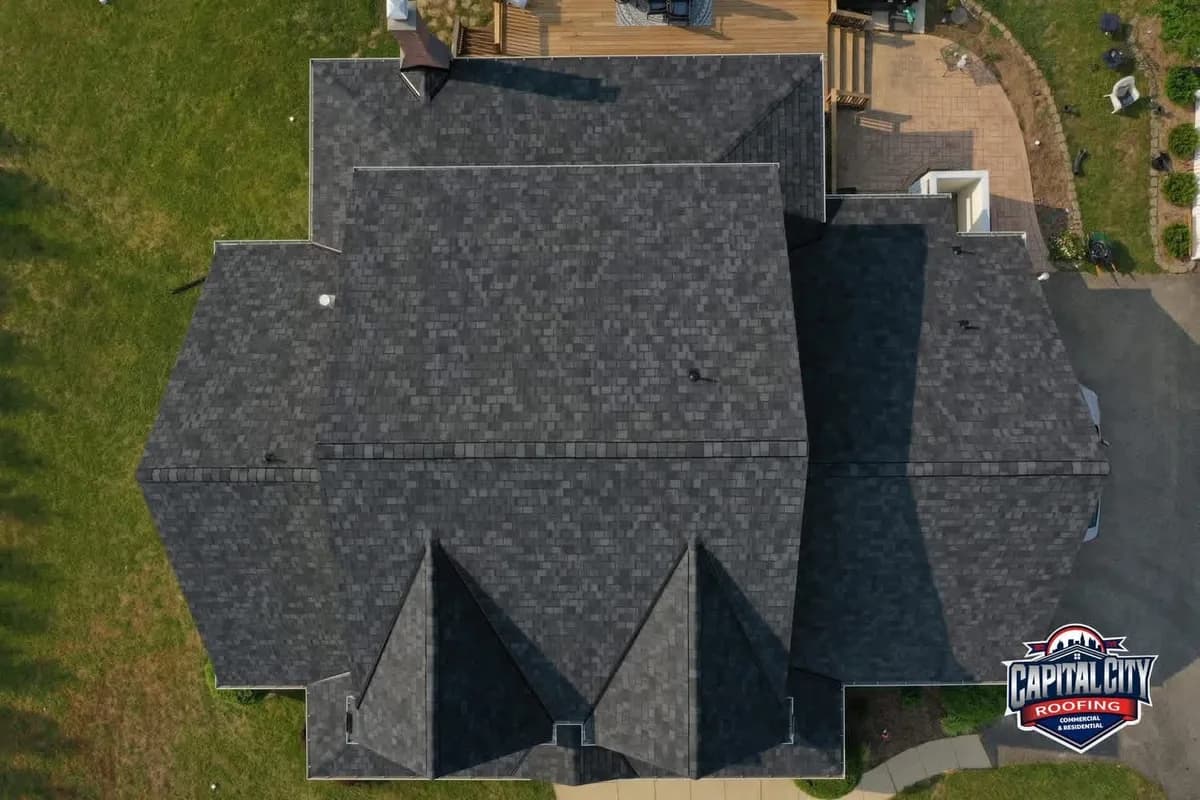
- Drone imagery: High-resolution aerial photos covering 100% of the roof surface, including areas that are difficult to inspect on foot
- Annotated damage maps: Every hail strike, every granule loss area, every mat fracture is marked, measured, and photographed at close range
- Weather verification: Storm path data, hail size reports from NOAA, and local weather station records that confirm the damage event
This documentation is the same standard we apply in every market we serve.
Adjuster Coordination
We meet your insurance adjuster on the roof. We walk the damage together, reference the documentation, and ensure the scope of work reflects the full extent of damage. This is not about inflating claims. It is about making sure nothing is missed.
Supplemental Claims
In many Greenville hail events, the initial insurance estimate misses items that only become apparent during tear-off: damaged decking, deteriorated underlayment, rotted fascia boards. Capital City Roofing files supplemental claims for every additional item discovered during the project, ensuring the insurance settlement covers the actual scope of repair.
Timeline
For storm damage roofing projects in the Greenville market, our typical timeline runs:
- Within 48 hours of storm: Initial inspection and damage documentation
- Within 1 week: Insurance claim filed with full BuilderLync report
- Within 2 to 4 weeks: Adjuster meeting and scope agreement
- Within 1 to 2 weeks of approval: Project scheduling and material ordering
- 1 to 3 days: Roof installation
Why Greenville Property Owners Choose Capital City Roofing
Capital City Roofing operates a permanent Greenville division with local leadership, local crews, and a long-term investment in the Upstate market. We are not a storm-chasing operation that rolls into town after a hail event and vanishes after collecting payment.
Certifications that matter:
- GAF Master Elite Contractor (top 1% of contractors nationwide)
- CertainTeed ShingleMaster Premier
- GAF Commercial Certified
- GenFlex Commercial Certified
- NRCA Member
Technology advantage: Our BuilderLync platform and AI-powered workflows deliver faster proposals, more thorough documentation, and better communication than any traditional roofing contractor. The same technology that powers our Atlanta flagship operation runs every Greenville project.
Local accountability: Lucas Anderson, Jason Breland, and Mary Evelyn Breland provide direct oversight on every Upstate project, from the initial inspection through final warranty activation.
About the Author
Brad Strawbridge is the founder and CEO of Capital City Roofing and wrote greenville sc storm season hail damage guide and co-founder of BuilderLync, the CRM and operating platform purpose-built for roofing contractors. A Forbes Business Council member and director on the RT3 and NRAP boards, Brad built Capital City Roofing on an AI-first operating model serving Greater Atlanta, Nashville, Charleston, and Greenville. He writes about roofing operations, AI adoption, and scaling service businesses at bradstrawbridge.com.
Related Reading
- Understanding Hail Damage: A Homeowner's Complete Guide
- Storm Season Roof Preparation Guide
- Post-Storm Roof Inspection: What to Look For
- How Your Roof Insurance Claim Actually Works
- Roof Replacement Cost in Greenville, SC: Complete 2026 Guide
Upstate property owner dealing with storm damage? Schedule a free inspection or call our Greenville team directly. Whether you need a post-storm damage assessment, a Class 4 upgrade consultation, or commercial roof evaluation along the I-85 corridor, Capital City Roofing has the local team and national-caliber credentials to protect your investment.
Brad Strawbridge
Founder & CEO · Forbes Business Council Member • RT3 & NRAP Board of Directors • GAF Master Elite® • CertainTeed ShingleMaster™ • NRCA Residential & Workforce Development Committees
Brad Strawbridge is the Founder and CEO of Capital City Roofing, bringing over a decade of hands-on expertise to the industry. He is an official member of the Forbes Business Council, the invitation-only community for vetted senior-level business leaders, and serves on the Boards of Directors of the Roofing Technology Think Tank (RT3) and the National Roofing Apprenticeship Program (NRAP). A member of the National Roofing Contractors Association (NRCA), Brad has been appointed to the NRCA Residential Roofing Committee and the NRCA Workforce Development Committee, helping set national standards for installation quality and the future of the roofing labor force. Under his leadership, Capital City Roofing has earned GAF Master Elite and CertainTeed ShingleMaster Premier, the top contractor credential from each manufacturer.