Charlotte NC Storm Damage Roofing: Assessment, Repair, and Insurance Claims

Charlotte's exposure to derechos, hail, and severe thunderstorms makes storm damage a reality for homeowners across Mecklenburg County. Learn the assessment, repair, and insurance claim process specific to the Charlotte market.
Charlotte, North Carolina sits in a geographic zone that receives a wide variety of severe weather. From the derecho events that have impacted Mecklenburg County to the hailstorms that sweep through the Piedmont region each spring, Charlotte homeowners face real and recurring storm damage risks.
Understanding how to assess damage, navigate the repair process, and manage your insurance claim effectively can mean the difference between a full recovery and thousands of dollars in out-of-pocket costs.
Charlotte's Storm Damage Profile
Charlotte's position in the western Piedmont of North Carolina exposes the metro area to several types of severe weather:
Derecho Events
Derechos are widespread, long-lived wind storms associated with fast-moving bands of severe thunderstorms. Charlotte has experienced multiple derecho events that produced straight-line winds exceeding 80 mph. These events cause widespread roof damage across large geographic areas, overwhelming local contractor capacity and creating extended timelines for repairs.
Hail
The Charlotte metro area receives hail events with measurable frequency. While the Piedmont does not experience the catastrophic hail seen in the Texas or Colorado markets, Charlotte regularly sees hail in the 1 to 2 inch diameter range, which is sufficient to cause significant damage to asphalt shingles, metal components, and soft metals like gutters and flashing.
Severe Thunderstorms
Charlotte averages more than 40 thunderstorm days per year. Individual thunderstorm cells can produce localized wind damage, heavy rainfall, and hail that affects one neighborhood while leaving adjacent areas untouched. This localized pattern means your home may have storm damage even when neighboring properties appear unaffected.
Assessing Storm Damage on Your Charlotte Property
After any significant weather event, a systematic assessment helps you identify damage and document it for insurance purposes.
What to Look for from the Ground
- Shingle debris in the yard: Finding shingle granules, tabs, or complete shingles in your yard or gutters is a clear indicator of roof damage.
- Damaged gutters and downspouts: Hail dents on gutters, displaced downspouts, and bent gutter hangers are often visible from ground level.
- Damaged siding and window screens: If your home's siding or window screens show hail damage, your roof has almost certainly sustained similar impacts.
- Soft metal damage: Check HVAC units, mailboxes, and decorative metal elements for hail dents. These serve as ground-level indicators of hail size and intensity.
Professional Roof Inspection
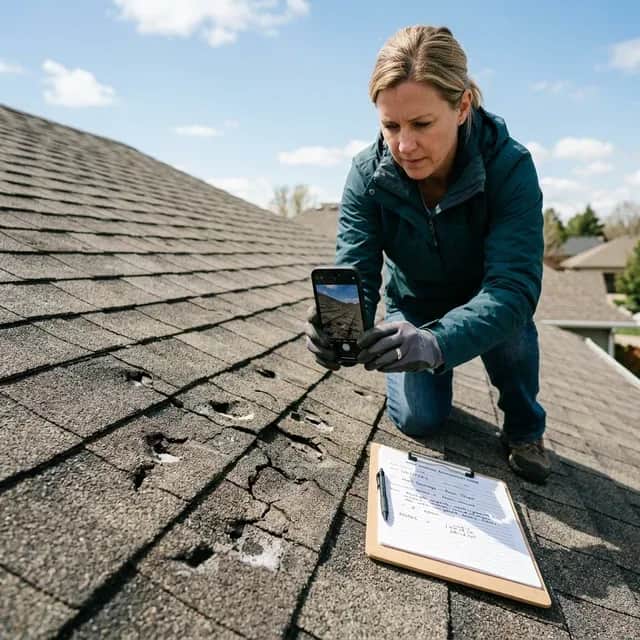
A ground-level assessment can identify obvious damage, but a professional roof inspection is essential for documenting the full extent of storm damage. A qualified inspector will evaluate:
- Shingle bruising: Hail impacts compress the shingle mat, causing bruising that may not be visible without close examination. The inspector presses on suspected impact areas to feel for soft spots in the shingle mat.
- Granule displacement: Hail strips protective granules from the shingle surface, accelerating UV degradation and shortening the roof's remaining life.
- Cracked or fractured shingles: Larger hail can crack the fiberglass mat embedded in the shingle, creating fractures that allow water infiltration.
- Flashing damage: Wind and hail can displace or damage flashings around pipes, vents, chimneys, and wall transitions.
For a detailed guide on what inspectors look for, see our understanding hail damage guide.
The Insurance Claim Process in North Carolina
Filing a storm damage claim in North Carolina involves specific steps and timelines that Charlotte homeowners should understand:
Step 1: Document the Damage
Before contacting your insurance company, thoroughly document all visible damage:
- Photograph the overall roof from multiple angles
- Take close-up photos of individual damage points
- Document ground-level evidence (gutter dents, siding damage, yard debris)
- Note the date and approximate time of the storm event
- Save any severe weather alerts or radar data for your area
Our storm damage documentation guide provides a comprehensive checklist for thorough documentation.
Step 2: File the Claim Promptly
North Carolina requires policyholders to provide timely notice of claims. While the state does not specify an exact number of days, insurance policies typically include prompt-notice provisions. Best practice is to file within 48 to 72 hours of discovering storm damage.
Step 3: The Adjuster Inspection
Your insurance company will assign an adjuster to inspect the damage. Important considerations:
- Be present for the inspection: Either you or your contractor should be present when the adjuster inspects the roof.
- Provide your documentation: Share your photos and notes with the adjuster.
- Request a detailed scope: Ask for a copy of the adjuster's damage report, including the Xactimate estimate that details every line item.
Step 4: Review the Initial Estimate
Insurance adjusters work from standardized pricing databases (typically Xactimate). Their initial estimates may not capture all necessary work. Common items that are frequently under-scoped:
- Starter strip and hip/ridge cap: These components are often damaged in storms but omitted from initial estimates.
- Drip edge replacement: North Carolina building code requires drip edge on all new roof installations. If your existing roof predates this requirement, the insurance estimate should include it.
- Code upgrades: When building codes have changed since the original roof was installed, insurance policies with "ordinance or law" coverage should cover the cost of bringing the new roof up to current code.
For more on this process, visit our insurance claims resource page.
Step 5: Supplemental Claims
If the initial insurance estimate does not cover the full scope of necessary repairs, a supplemental claim can be filed. Supplements are common in storm damage claims and are a normal part of the process, not a confrontational act.
Capital City Roofing prepares detailed supplemental documentation with line-item comparisons, photographic evidence, and code references to support fair claim settlements.
Charlotte Neighborhoods and Storm Damage Patterns
Storm damage patterns vary across Charlotte's diverse neighborhoods:
Ballantyne: Newer construction with higher-quality materials generally weathers storms better, but even premium shingles sustain hail damage. HOA coordination is often required for replacements.
South End: A mix of older residential and newer mixed-use development. Older homes may have aging roofs that are more susceptible to storm damage, while newer construction typically meets current wind code requirements.
University City: Large-format apartment complexes and commercial buildings in this corridor often require phased storm damage repairs to maintain occupancy.
NoDa (North Davidson): The neighborhood's mix of historic homes and renovated properties presents varied roofing conditions. Historic structures may have unique material requirements that affect storm damage repair costs.
Repair vs. Replacement After Storm Damage
Not every storm damage claim results in a full roof replacement. The decision depends on several factors:
- Extent of damage: If damage is limited to one slope or a small area, a repair may be sufficient.
- Roof age: If your roof is within the last third of its expected lifespan and has sustained significant damage, replacement often makes more financial sense.
- Material availability: Matching existing shingle colors and profiles can be challenging, especially if the product has been discontinued.
- Insurance coverage: Your policy terms (replacement cost vs. actual cash value) significantly affect the financial calculus of repair vs. replacement.
Capital City Roofing's Charlotte Storm Response
Capital City Roofing maintains a dedicated storm response team for the Charlotte metro area. Our storm damage assessment process includes:
- Free post-storm roof inspections
- Comprehensive damage documentation
- Insurance claim filing assistance
- Supplemental claim preparation
- Storm damage repair and full replacement services
We work directly with your insurance company to ensure your claim reflects the full scope of necessary repairs, and we never ask homeowners to pay more than their policy's deductible for covered storm damage work.
Charlotte property impacted by a recent storm? Schedule a free storm damage assessment or call our Charlotte team directly. We respond to inspection requests within 24 to 48 hours across Mecklenburg County.
Brad Strawbridge
Founder & CEO · Forbes Business Council Member • RT3 & NRAP Board of Directors • GAF Master Elite® • CertainTeed ShingleMaster™ • NRCA Residential & Workforce Development Committees
Brad Strawbridge is the Founder and CEO of Capital City Roofing, bringing over a decade of hands-on expertise to the industry. He is an official member of the Forbes Business Council, the invitation-only community for vetted senior-level business leaders, and serves on the Boards of Directors of the Roofing Technology Think Tank (RT3) and the National Roofing Apprenticeship Program (NRAP). A member of the National Roofing Contractors Association (NRCA), Brad has been appointed to the NRCA Residential Roofing Committee and the NRCA Workforce Development Committee, helping set national standards for installation quality and the future of the roofing labor force. Under his leadership, Capital City Roofing has achieved elite certifications held by fewer than 1% of contractors nationwide.