How to Identify, Repair & Prevent Hail Damage: An Expert Guide for Homeowners

Capital City Roofing CEO Brad Strawbridge was featured as the expert in Bottom Line Inc's comprehensive guide to hail damage. Learn how to identify damage, navigate insurance claims, and protect your home.
Originally published as a featured expert article in Bottom Line Inc - April 9, 2026
Brad Strawbridge, CEO of Capital City Roofing, was recently featured as the expert source in Bottom Line Inc's comprehensive guide to hail damage for homeowners. Bottom Line Inc - a nationally recognized consumer advice publication - selected Brad to share his extensive storm-restoration expertise with their readership of millions.
Hail causes between $8 billion and $14 billion in losses each year in the US and accounts for 50% to 80% of all thunderstorm-attributed losses. In 2025 alone, there were 5,432 hail incidents across the country. Here's what every homeowner needs to know.
Where to Look First: Spotting Hail Damage Starts at the Street
Most homeowners rush straight to the roof after a hailstorm. But as Brad told Bottom Line, the signs of hail damage start at the street.
The first step is checking for collateral damage on soft metals and other vulnerable surfaces:
- Electrical boxes and mailboxes - Dents on these soft-metal surfaces are easy to spot
- Air-conditioner units - Broken plastic covers or bent metal coil fins on outdoor units and heat pumps
- Vehicles - Dents on the roof and hood, surface indentations (run your hand over panels to feel them), cracks in windshields and windows
- Plants and landscaping - Tears in large-leaf vegetation, broken small branches and stems
Pro Tip from Brad: "At Capital City Roofing, we train our staff to look for hail damage to vehicles during the initial inspection after a hailstorm. If cars in the driveway are dented, the roof likely took damage too."
Walking the Elevations
After checking collateral damage, walk the perimeter of your property and inspect three critical areas:
Siding: Hail doesn't just fall straight down - it moves laterally with the wind. Vinyl siding is particularly vulnerable. As Brad explained to Bottom Line: "If you think about any hailstone bigger than an inch and three-quarters or two inches, if it's moving laterally at any type of velocity and that vinyl is brittle, it's going to crack." Look for broken pieces, smaller fractures, and dents spread across entire wall surfaces.
Windows: Damage varies by region. In Texas, large hail can completely shatter glass. In other areas, you're more likely to see screen damage - but even screen damage can help substantiate an insurance claim.
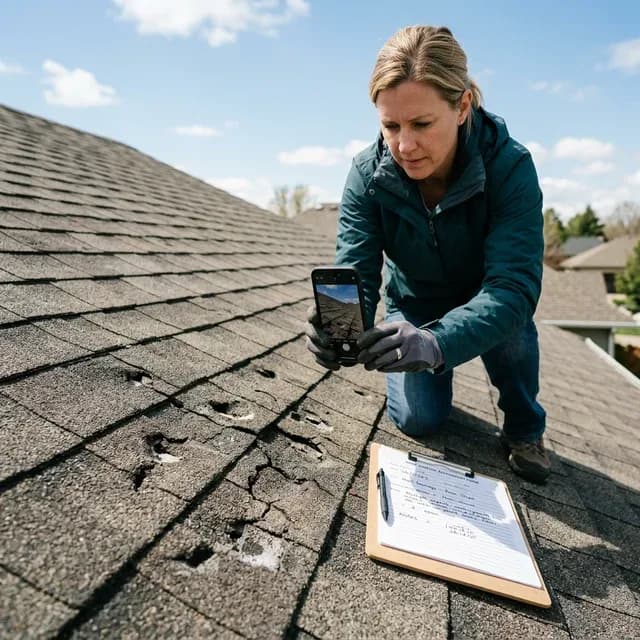
Roofing: This is the last piece of the puzzle. Look for:
- Strike damage (bruises or craters with embedded granules on asphalt shingles)
- Wind-creased shingles (where wind lifted and bent the shingle)
- Displaced hip and ridge shingles (these are held by only 2–4 nails vs. 4–6 for field shingles)
Related Reading:
Hail Damage by Roofing Material
Different roofing materials respond to hail in different ways:
| Material | What to Look For |
|---|---|
| Asphalt Shingles | Bruises/craters, expelled granules, outward impact rings |
| Metal Roofing | Dents, dings, displaced seams, punctures, damaged protective coatings |
| Clay & Concrete Tile | Cracked tiles, chipped edges, fractures, broken corners |
| Wood Shingles/Shakes | Splits, cracks, impact marks, crushed fibers, displaced pieces |
In every case, the critical question is whether the hail caused functional damage - not just cosmetic marks. That means checking whether the material's water-shedding capability, structural integrity, or expected lifespan have been compromised.
As Brad explained: "We also look at related components such as flashing, ridge caps, vents, gutters, and soft metals, because they often help confirm the severity and direction of the hail event."
Not sure about your roofing material? Check out our Metal Roofing vs. Asphalt Shingles comparison or GAF vs CertainTeed comparison to understand how different materials perform under stress.
Understanding Hail Swaths: Why Your Neighbor's Roof May Be Fine
Hailstorms tend to be localized, so damage can vary dramatically among homes in the same city - even the same neighborhood. According to the NOAA National Severe Storms Laboratory, hail falls in paths called "hail swaths" that can be as narrow as a few acres or as wide as 100 miles. Don't assume your home is fine just because other people's homes are fine - do a thorough check after every hailstorm.
Unless you have experience with storm restoration, it can be difficult to differentiate between minor and major damage. Superficial cosmetic dents can be ignored, but if there's any risk for water intrusion, contact a professional.
The Insurance Process: What Homeowners Need to Know
Most hail damage repairs are covered by homeowners insurance. The key principle is "pre-loss condition" - your home should be restored to the state it was in before the storm.
This often means more than a simple repair. Brad gave this example to Bottom Line: "A lot of times, that vinyl isn't technically repairable because you can't match it. It is the insurance carrier's responsibility to bring the home back to its pre-loss condition, so if there was matching vinyl siding on the home before the damage, the insurer has to pay to bring that siding back to that same condition - and that could mean doing a full replacement."
Critical Warning: Review Your Policy Annually
One of the most important takeaways from the article: Your insurance policy can change without your active awareness.
Brad shared this cautionary insight: "I've had customers tell me that their policy changed without them knowing it because their carriers sent a letter via normal mail to their mailboxes, which qualifies as doing their due diligence."
He has seen customers' deductibles jump from $1,000 to $5,000, with added exclusions and roof-replacement contingencies. At that point, filing a claim may not even make financial sense.
Deep Dive into Insurance:
Repairing Hail Damage
Most repairs from hail damage are covered by homeowners' insurance. This means the home will be repaired to "pre-loss condition." But as Brad explains, that usually entails more than just a simple repair.
Most homeowners insurance plans have deductibles, so it won't necessarily cost you more to do a full replacement. If you have a $1,000 deductible, that's what you'll pay regardless of whether you need a $2,000 repair or a $15,000 roof replacement.
How to Prevent or Minimize Hail Damage
While you can't stop a hailstorm, you can take steps to minimize the damage:
- Park vehicles under garages or carports when storms are expected
- Cover outdoor equipment - grills, furniture, fragile items
- Board up windows with OSB (oriented strand board) for catastrophic-level storms - the same prep used for hurricanes
- Protect smaller plants with breathable covers, tarps, or buckets
- Maintain trees through regular pruning to reduce breakage risk
After the Storm: Document Everything
As Brad emphasized to Bottom Line: Documentation is your most powerful tool. Take video of hail falling from a safe location, then photograph hail size immediately after the storm stops. Without this evidence, insurance carriers can argue: "How do we know this all happened that day?"
If there is obvious damage, you can mitigate leaks by placing tarps on affected areas - but only if you can safely reach them by standing on a ladder. The roof is often slippery after a hailstorm, so avoid stepping on it. For broken windows, tape plastic sheeting around them to stop the weather from getting in.
Learn More About Storm Preparation:
Choosing the Right Storm Restoration Company
Brad's advice to Bottom Line readers applies universally: Be cautious about who you hire.
After a major hailstorm, door-knockers will flood affected neighborhoods. Many commit fraud against both homeowners and insurance companies. Brad recommends:
- Don't go with the first person who knocks on your door
- Research the company - check Google reviews, community reputation, certifications
- Partner with someone who speaks intelligently about how they'll handle your claim
Capital City Roofing is proud to be GAF Master Elite Certified, a member of the Roofing Alliance, and trusted by homeowners across the Southeast.
Contractor Selection Guides:
About the Expert
Brad Strawbridge is the founder and CEO of Capital City Roofing, a GAF Master Elite and CertainTeed ShingleMaster Premier certified contractor serving Georgia, Tennessee, and South Carolina. He was selected as the featured expert for this article by Bottom Line Inc.
Brad Strawbridge
Founder & CEO · Forbes Business Council Member • RT3 & NRAP Board of Directors • GAF Master Elite® • CertainTeed ShingleMaster™ • NRCA Residential & Workforce Development Committees
Brad Strawbridge is the Founder and CEO of Capital City Roofing, bringing over a decade of hands-on expertise to the industry. He is an official member of the Forbes Business Council, the invitation-only community for vetted senior-level business leaders, and serves on the Boards of Directors of the Roofing Technology Think Tank (RT3) and the National Roofing Apprenticeship Program (NRAP). A member of the National Roofing Contractors Association (NRCA), Brad has been appointed to the NRCA Residential Roofing Committee and the NRCA Workforce Development Committee, helping set national standards for installation quality and the future of the roofing labor force. Under his leadership, Capital City Roofing has achieved elite certifications held by fewer than 1% of contractors nationwide.